In this powerful and deeply reflective piece, we hear from Kwaku Aurelien—a law student at UConn School of Law, an advocate, and sickle cell disease (SCD) Warrior—whose journey sits at the intersection of lived experience and legal advocacy. As a Sick Cells Ambassador and dedicated advocate for the SCD community, Kwaku shares how navigating SCD has not only shaped his identity, but also sharpened his commitment to advancing equity through law and policy. Most recently, he served as a state Team Lead during our 2026 SCD Policy Forum, engaging directly with congressional offices to advocate for federal priorities impacting the SCD community. From the classroom to the policy arena, his story is a testament to resilience, purpose, and the evolving meaning of what it truly means to be a “Warrior.”
I AM WHAT A WARRIOR LOOKS LIKE by Kwaku Aurelien
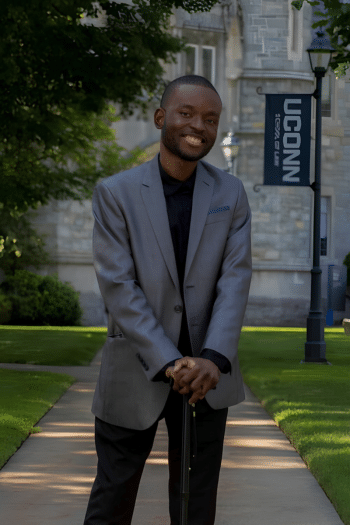
“I am pictured here with a cane. I underwent a hip replacement surgery for AVN a mere month before this picture was taken in August. What I want Warriors to take away is that I am you and you are me.”
When asked what area of law I want to go into, I’m quick to reply with, “I’m thinking between health and environmental.” A good friend and now-classmate of mine who I met before law school asked me recently if environmental law is still my focus. I told her it’s an interest, but that things have evolved in recent years. Those answers belie the full truth.
This past Fall, I enrolled in UConn Law’s Disability Rights Clinic, where, for our final project, we were assigned with creating a “Know Your Rights” fact sheet on a disability law issue of our choice and then presenting on it. I chose to do mine on the Family and Medical Leave Act (FMLA), incorporating two real-world civil cases into the sheet to illustrate how specific elements of the FMLA play out in given situations. In addition, I translated legal jargon into layman’s terms to make the fact sheet accessible or more accessible to any ordinary person.
I have sickle cell disease (SCD) hemoglobin SS. Of the two cases I selected, one featured a plaintiff who has SCD, and the other a plaintiff with a child with SCD. What attracted me to the FMLA despite having no familiarity with employment or family law beforehand was the understanding that there could be a situation which befalls me in the future where knowledge of its ins and outs might be critical. But it goes beyond just me. It goes beyond SCD even, despite it being the focus. My fact sheet can apply more broadly to other chronic illnesses and disabilities. For that reason, the fact sheet as of now is a living document that I have and will be continually adding to. When I’m done, I plan on disseminating it and supporting materials, such as visuals like the one in the cover image, video and/or audio, and Spanish translation, to my SCD networks.
This Wednesday, I was the Team Lead for the state of Connecticut during the 2026 #SCDPolicyForum hosted by Sick Cells. I met with four state legislative staffers (three meetings screenshotted below), the first with Nellychris Omeonu, to make federal policy asks important to the SCD community heading into Fiscal Year 2027.

With Maria Costigan, Deputy Chief of Staff, with Rep. Joe Courtney

With David Seyferth, Legislative Assistant, with Rep. Jahana Hayes

With Sebastian Cardona-Negron, Legislative Correspondent, with Sen. Chris Murphy
Does my condition define me? No. Far from it. But it does inform my identity. It’s impossible for it not to. In fact, I am proud on account of it.
I am proud to be a Warrior. Only we – those of us who live with the condition, as well as our family members, caregivers, clinicians, and advocates – know and can appreciate what that means. In a society that doesn’t value what it doesn’t see, it is easy to write off people bearing invisible scars. For us however, having the knowledge that no two Warriors are the same, I and another don’t have to have experienced all the same things to know what the other is talking about. Our paths can never cross and we will still be in community.
I remember last Spring during Legal Practice when a classmate mentioned she used to work with kids with sickle cell. How my eyes widened, and how I refrained from approaching her to speak with her about her experience after class. I had been thinking by the end of the day Wednesday I would share, but as though the stars had aligned, I came across a short video the next day on my IG feed from Dr Lewis Thomas that solidified my intent. Coming out in a world that is indifferent at best and hostile at worst, as Dr. Thomas states, can feel terrifying. But it doesn’t do other Warriors any good for them to have no idea that I’m out there, nor does it do me any good not knowing that they are out there just waiting to connect. It is my hope that this post will reach them.
But I’ve come to an even more important decision. I want to dedicate my life to SCD. From a legal standpoint, this is hazy; law review authors have made compelling arguments for why justice for people living with SCD will never be forthcoming through the courts, minus an overhaul of American law and medicine themselves. I sat with that my whole first full 1L semester, Fall 2024, when I found that particular article on my own and read it, and privately wondered, “Am I walking a path that may no longer fit me?”
Since then, I’ve been able to sharpen my blade enough to slice through some of the fog. I may be able to assist individuals in several ways, whether it be a Social Security or Medicaid issue or diagnosing environmental hazards that negatively affect our health relative to others; environmental law is the first law course I can say I mastered, and just last month, I was looking into whether New York has equivalents to Connecticut’s environmental citizen suits and affecting facilities statutes for a curious cousin. In Fall 2024, I was a research volunteer for UConn Law’s chapter of the International Refugee Assistance Project, and should scheduling permit it, I would like to take immigration law this coming Fall, as the only difference between me and Anadith Danay Reyes Alvarez is where we happened to be born.
In fact, having visited with other Warriors in Ghana (pictured below), as well as being steeped in the universal language that is law here at UConn, I don’t see any reason why I couldn’t create materials for people in other countries based on their laws. I’m going to follow my own path, wherever it takes me, and how long.

Sickle cell has cost me personally. I was admitted to UConn Law in 2022, and I had to go on not one, but two leaves of absence for reasons related to it. It continues to cost me today, but I have always been able and willing to pay the tab and then deposit the refund check in defiance. That is what it means to be a Warrior.
I don’t look the part, but since 2022, I have been battling my own body and my grief for the loss of my father, who was my best friend and the biggest proponent for me going into law, and who passed due to cancer in 2023, all to complete a degree. If that isn’t emblematic of a warrior in the traditional sense, I don’t know what is. But here is thing: I would not have ceased being one if I yielded and did not return to law school. Moreover, no matter how much respect and recognition I may garner for my seeming resilience, if that same respect and recognition is not accorded to people like me who physically can’t do the same things, as far as I’m concerned, it doesn’t exist for me.
I have come to understand a few things, which ultimately should be the takeaways for any Warrior who comes across this. I could attain a law degree tomorrow. I could undergo a curative therapy tomorrow and it be a success. Those things, neither individually or together will make me the best version of myself. Only the inner work can do that.
Secondly, it is imperative that we be kind always, but most of all, we need to be kind toward ourselves. Kindness towards myself is something I admittedly struggle with. As Warriors, we know the limitations inherent to our condition. It is not a matter of viewing those limitations as things that disqualify us from certain aspects of life, but rather of acknowledging their existence and doing our best to operate within those constraints. We have to develop a strong sense of self to move through the world undeterred by the ways in which others define us (we will never come out unscathed). Embrace of the term “Warrior” over a pejorative, imposed term like “sickler” is one of the ways in which the SCD community already does this. But as I have come to learn through my SCD networks, even “Warrior” carries negative connotations, such as the idea of perpetually being in conflict. Ultimately, for as much as I personally like that term, it is up to each of us ourselves to determine what concept of self we deem most appropriate.
Maya Angelou once said, “There is no greater agony than bearing an untold story inside you.” That tension is one I and others like me are forced to live with every single day. For me, it does not leave merely by sharing what I worked on this week. For all I know, it may never leave me fully. But this is my first step towards ameliorating it. Feeling inspired by what I’ve outlined here is valid. But the reasons I chose to share were in hopes of reaching other Warriors and to claim the part of my identity the world taught me I must suppress.
The last verse Tupac Shakur* sang in “Mamma’s Just a Little Girl” moved me. It goes:
“You see, you wouldn’t ask why the rose that grew from the concrete had damaged petals. On the contrary, we would all celebrate its tenacity. We would all love its will to reach the sun. Well, we are the roses, this is the concrete, and these are my damaged petals. Don’t ask me why. Ask me how. [Laughs]”
Warriors, we are the roses. When someone asks you why you push so hard despite your seeming fragility, or conversely, why you don’t seem to push hard enough despite your seeming normalcy, tell them, “Don’t ask me why. Ask me how.”
There is a quote in the novel Invisible Man by Ralph Ellison that encapsulates not only my story but those of so many Warriors all over the world. For those struggling with their identity or with making sense of where they fit into this world picture, I offer its wisdom to you. It reads:
“I was looking for myself and asking everyone except myself questions which I, and only, I could answer. It took me a long time and much painful boomeranging of my expectations to achieve a realization everyone else appears to have been born with: That I am nobody but myself. When I discover who I am, I’ll be free.”
More to come.
*The decision to include a verse from Tupac was not made lightly, despite his contributions to hip-hop and his political activism on behalf of Black, poor, and working-class people. For those who don’t know, Tupac once mocked Prodigy of Mobb Deep for his sickle cell disease. Prodigy struggled with sickle cell his entire life, speaking about it in interviews and even making it the subject of one of his songs. I nevertheless decided to include the lyric because I thought it provided a powerful and accurate metaphor for the sickle cell disease experience.
Published April 2026