
Sick Cells sat down with Mariah Jacqueline Scott, MS, MPH, a sickle cell warrior and Sick Cells Research Consultant, to discuss her personal experiences navigating barriers to care and how those experiences have shaped her advocacy and research. Mariah is currently pursuing her Ph.D. in Prevention Science at Rutgers University, where her work focuses on improving care and outcomes for people living with sickle cell disease.

What does access to sickle cell treatments mean to you?
Access is not just receiving treatments It’s unlocking quality of life. How can I unlock being the best mom I could for my daughter, Autumn? Or how can I unlock doing the things that I love again, despite having sickle cell and having less coverage and access? And I think that’s very important, not just for our community, but also for a lot of payers, researchers, and any other decision-makers, to understand: paying to get access to these therapeutics, means more than just paying for a drug. It means that we’re paying for the best life that we can have.
What treatments have helped unlock a better quality of life for you?
One of the disease modifiers that I’m on is Adakveo. I’ve been on it since it came out in 2019 and it’s been a game changer for me, knock on wood. But I’ve had challenges getting access to it.
I live in New Brunswick at the center of New Jersey and I go to school in Camden, which is about an hour and five minutes southwest from me. I have a hematologist down in Camden and they have an infusion center. So I tried to get Adakveo when I’m down there so it’s a one-stop deal. But unfortunately, my insurance doesn’t cover it because that location is billed as a hospital and not as an outpatient clinic. So now I have to make monthly appointments back in North Jersey and travel across the whole state to get the treatment I need.
Have you encountered other challenges accessing the care you need?
Right now, I’m in a legal battle with my health insurance because they won’t cover the back surgery that I need. Even though it’s fairly common and a procedure that is done often in cancer cases and elderly patients: they’re just going in and putting cement to stabilize the bone. But they’re not covering it because they don’t see it as medically necessary.
In my research, when I was looking at why they don’t see it as medically necessary, insurance companies do a lot of systematic reviews: they base coverage on a few conditions like cancer, osteoporosis, old age—but nothing with sickle cell. So now I have to find lawyers and actually have a court case to get coverage on that back surgery.
In the meantime, it’s really impeding my quality of life. It’s painful enough to wake me up at night. Picking Autumn up and playing, it hurts. My husband took the week off to help me with the surgery, but the insurance company denied coverage and canceled the surgery the day before, and he wasn’t able to reschedule his time off—which meant we had to cancel our honeymoon, since he didn’t have enough days left for the year.
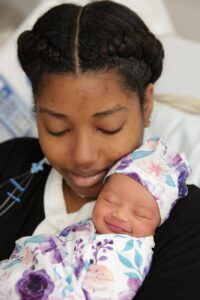
Mariah and her daughter
As a researcher and Ph.D. student, how have your personal experiences navigating health care shaped your understanding of the challenges others face?
I still have a hard time navigating insurance! But I just finished up one of my research projects where there were focus groups with warriors from 13 to 26. We also did a focus group with caregivers. There were a lot of comments like, “I don’t know what a copay is, I don’t know what a deductible is. If I have a problem with my Medicaid that helps me with transportation, where is that hotline number?”
Maybe that should ring a bell and ring some type of alarm for Medicaid. If someone’s 18 or just turned 18, let’s send an email or call them and say, “Hey, would you like to see this webinar, a link we have about copays and deductibles?”
There are also lots of information gaps about drug and treatment options from providers. For example, a lot of warriors and caregivers heard about gene therapies, of course, from the news and social media, but a lot of them did not hear about Adakveo. A lot of them did not hear about Endari or the clinical trials where patients could take both hydroxyurea and Adakveo/Endari.
Some of those gaps are related to pricing. I’ve heard a couple of providers saying, “Well, I don’t suggest Adakveo because of the price.” Well, can you at least explain it to the patient to see if they even want to try it? There’s programs out there to help pay for that.
We need to continue educating what pricing means in everything that we do (as insurers, clinicians, advocates, and warriors) and making it as forward-looking as possible. For example, with my back surgery: my insurance will pay me to get a full liter of hydration and three doses of Dilaudid. That’s a lot cheaper than paying for anesthesia and the cement in the short-term, but long-term it’s not — it’ll be $2,000 every two weeks to manage the pain instead of the one-time cost of a surgery.
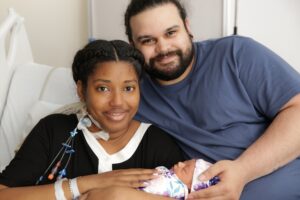
Mariah and her family
Your research focuses on strengthening resources for the SCD community. Can you tell us more about the interventions you’re developing?
I’m focused on warriors’ transition from pediatric care to adult care for sickle cell disease. My own experience with that transition included a crisis when I was a teenager. A doctor treating me didn’t know you couldn’t give prednisone to people with sickle cell because it can cause crises. When I woke up from the crisis the steroid caused, I was in the ER because I passed out from pain. I was seen as an adult and assigned an adult provider, a hematologist who said, “Hi, I’m Dr. So-and-so.”
And then that was it—my transition from pediatric to adult care. My new provider had one phone call with my pediatric doctor and I never looked back.
That was in 2010. Now we’re in 2026, we’re still seeing teens having a high rate of mortality and a bad quality of life during this transition. Think back to what your perspective is like when you’re a teenager: I want to do everything. I think I’m Superman, but I also don’t want to talk about my sickle cell. I’m embarrassed. I really just want to help make programs and implement more research and programs for teens during this time. In my Prevention Science program, we learned how to do just that.
I’m designing an intervention that addresses a big community piece that’s missing from teenagers’ transition [from pediatric to adult care]. A lot of that transition happens in hospitals or clinics. Here’s your pediatric provider, here’s your adult provider, and that’s it.
Right now, there aren’t many spaces for girls living with sickle cell to connect with others that look like them, like a girls’ night out where they can talk about school, college, reproductive health, or even dating.
That same community-centered piece is also missing for caregivers. It’s not just the warrior transitioning. The whole family is transitioning. They need space to ask questions like, “What does that look like for my child going to college?”
To learn more about coverage and therapeutics, join Sick Cells November 4-5, at the Sick Cells Therapeutic Conference, held virtually.
Published Oct 2026